Why Do People Ask AI for Recommendations Instead of Searching Now?
The convenience math changed. Your customers already voted.
The short answer: People ask AI for recommendations because one direct answer is faster than scanning a page of links. According to BrightLocal's 2026 Local Consumer Review Survey, consumer use of AI to find local business recommendations jumped from 6% to 45% in a single year. This is not a forecast. It already happened. The question for any business owner is whether the AI answering those questions knows enough about you to recommend you.
What Changed About the Way People Search?
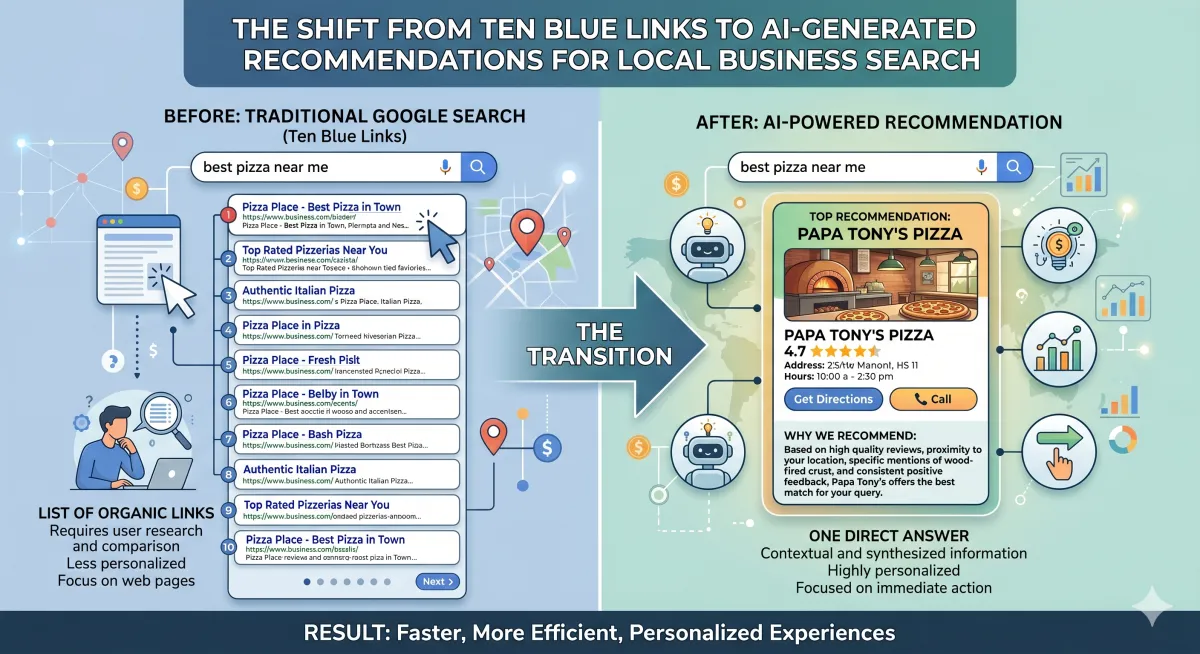
For twenty years, the process looked the same. You typed a question into Google, got a page of ten blue links, clicked three or four, and decided for yourself. The work of choosing sat with you. AI changed that. Now people type a question into ChatGPT, Perplexity, or Google's own AI Overviews, and they get a single curated answer. No scrolling. No comparing.
The shift happened faster than most business owners expected. A Search Engine Land study found that 37% of consumers now start their searches with an AI tool rather than a traditional search engine. Google itself added AI Overviews to its results page, and according to Xponent21's April 2026 data, AI-generated answers now appear in roughly 60% of U.S. search results.
That means even people who open Google first are often getting an AI-curated answer before they ever see a traditional link. The ten blue links still exist. They just moved down the page, below an answer most people read first.
Why Does One Answer Beat Ten Blue Links?
The math is simple. Ten links require ten decisions. One good answer requires one. People chose the path that costs them less time and less effort, and they chose it so quickly that the shift was well underway before most businesses noticed.
Think about the last time you needed a recommendation. A plumber. A restaurant in a town you were passing through. A CPA who understands small business. The old way meant opening multiple tabs, reading reviews across different sites, comparing credentials, and still not being certain. The new way means asking a question in plain language and getting a direct answer in seconds.
This is not a technology preference. It is a convenience preference. The same instinct that made people choose the drive-through over the sit-down, the text over the phone call, and the direct deposit over the paper check. Anything that makes a routine task faster, easier, and less expensive tends to win. It does not need to be perfect. It just needs to be faster than the alternative.
Pew Research Center data from March 2026 shows that 57% of U.S. adults now interact with AI at least several times a week. These are not early adopters chasing the newest thing. These are regular people making regular decisions and choosing the tool that gives them the answer fastest.
For anyone under 30, this is not even a shift. It is a starting point. They grew up with voice assistants, recommendation algorithms, and search tools that learn from their behavior. Asking an AI for a recommendation feels as natural to them as opening a phone book felt to their grandparents. The business that treats AI search as something only younger people do misunderstands who is doing it. Pew's data shows adoption among adults over 50 grew faster in 2025 than any other demographic. This is not generational. It is directional.
Are You Already Using AI Without Realizing It?
Most people who say they will never use AI already use it every day. Netflix, Spotify, smartphone cameras, spam filters, voice assistants, traffic routing, autocomplete, fraud detection. AI runs quietly through the devices and services people already trust without thinking twice about it.
When Netflix suggests a show you end up watching, that is a recommendation engine powered by machine learning. Netflix's AI-driven system drives over 80% of the content people watch on the platform, according to analysis published by DigitalDefynd. When Spotify builds a playlist based on your listening history, that is AI. When your phone sorts photos by faces or locations, that is AI. When your email filters spam before you see it, that is AI. When you ask Siri or Google Assistant for directions, that is AI.
The smartphone in your pocket runs AI dozens of times a day. The television in your living room uses it to decide what to show you next. The maps app rerouting you around traffic, the autocomplete finishing your sentences, the fraud alert catching a suspicious charge on your card. All AI. Already running. Already trusted enough that most people do not even think about it.
The people who say they refuse to use AI are not refusing AI. They are refusing the label. The technology itself, they adopted years ago without a second thought.
This matters because it reframes the conversation. The question is not whether AI will become part of how your customers make decisions. It already is. The question is whether the AI making those decisions has enough information about your business to recommend you.
What Does This Mean for a Business That Has Not Shown Up Yet?
If a potential customer asks an AI tool to recommend a business in your category and your area, and your business is not in the answer, you were never in the running. You did not lose that customer to a competitor. You lost them to silence. They never knew you existed.
According to BrightLocal's research, after getting an AI recommendation, 62% of consumers search Google to verify what they heard, 58% visit the business's website directly, and 52% click through to the sources cited in the AI response. The AI recommendation becomes the starting point, not the ending point. But if you are not in the starting list, none of that verification behavior benefits you.
The information AI pulls from is not mysterious. Your Google Business Profile tells it your location, hours, and services. Your website tells it what you specialize in and how you talk about your work. Your reviews tell it what your customers think. Published articles and blog posts tell it what questions you can answer with authority. Structured data, the labels embedded in your website's code, tells it which facts to trust enough to cite.
This is not a crisis to panic about. It is a gap to close. The AI recommendation engine is forming opinions about businesses in every category and every market right now. It forms those opinions based on whatever information it can find. If that information is thin, outdated, or missing, the engine either skips you or gets you wrong.
The businesses that show up clearly and consistently in the places AI pulls from are the ones that get recommended. That is not a technology problem. It is a visibility problem, the same kind of visibility problem businesses have always faced, with new rules.
Why Do Some Business Owners Resist Something They Already Use?
The resistance is honest and understandable. The AI conversation has been dominated by people selling hype on one side and people dismissing the whole thing on the other. Neither camp sounds like a normal business owner trying to run a business well, and neither is particularly helpful.
But the data from the U.S. Census Bureau's May 2026 report on AI use in American businesses shows that AI adoption among small businesses is climbing steadily, even among owners who would never describe themselves as tech-forward. The adoption is not driven by excitement about technology. It is driven by the same thing that drives every business decision: something works, and the cost of not using it becomes harder to justify.
The business owner who says "AI is not for me" while asking Siri for directions, getting Netflix recommendations, and relying on Gmail's spam filter is not anti-AI. They are anti-label. Once the conversation shifts from "Do you use AI?" to "Do your customers use AI to find businesses like yours?" the resistance usually softens. Because the answer to the second question, for nearly every business in every market, is yes. They already do. The only question left is whether your business is part of what they find.
What Happens When the Recommendation Engine Does Not Know You Exist?
Nothing dramatic, and that is the problem. There is no alert, no notification, no phone call telling you a customer asked about your category and you were not mentioned. You simply do not show up. The customer gets a recommendation for someone else, verifies it with a quick search, and moves on with their day.
This is different from losing a sale because a competitor had a better ad or a better price. This is losing a sale because you were not in the room when the question was asked. The room, increasingly, is an AI-generated answer. And the businesses in that room are the ones that have done the work of making themselves understandable to the systems generating those answers.
A 2026 BizBuySell report found that 83% of small businesses already using AI tools report measurable results. The businesses showing up in AI recommendations are not necessarily bigger or better funded. They are more visible in the specific ways that AI systems can read and interpret.
Why Is This an Opportunity and Not Just a Threat?
Because the playing field is more level than it has been in years. AI recommendations pull from content quality, not ad spend. A solo business owner who publishes clear, honest, regularly updated content has a real chance at showing up alongside, or ahead of, larger competitors who spent more on advertising but less on substance.
Five years ago, showing up online required significant paid advertising, a sophisticated SEO strategy, and usually a marketing team or agency managing it all. The businesses with the biggest budgets dominated the first page of Google. Solo operators and small shops were structurally outmatched.
AI recommendations work differently. They favor specific, useful, well-structured information over keyword-stuffed pages with big budgets behind them. A third-generation petroleum distributor in Central Florida now handles incoming fuel orders through an AI assistant named Emma, routing orders to the right team member without anyone tied to a phone or a desk. Real estate professionals in Southwest Montana are showing up in AI answers about their local market because they invested in content and structured data that answer the questions buyers actually type into these tools. These are not tech companies. They are small businesses that did the visibility work.
The shift from "who pays the most" to "who communicates the most clearly" is a genuine structural advantage for small businesses willing to do the work. Not complicated work. Not deeply technical work. Consistent, clear, honest work: writing about what you do, keeping your online presence accurate, making sure the information AI can find about you is the information you want it to find.
The businesses that start now build a lead that compounds. A business that has published 50 clear, useful articles about its area of expertise looks more credible to an AI engine than one that published three articles last month in a rush to catch up. The advantage goes to the steady, not the flashy. For most small business owners, that should be welcome news.
Frequently Asked Questions
Is AI search replacing Google?
Not replacing, but reshaping. Google itself added AI Overviews to its results page, which means even traditional Google searches now often deliver an AI-curated answer before the list of links. AI tools like ChatGPT and Perplexity handle a growing share of informational and recommendation queries. The shift is not one replacing the other. It is AI becoming a layer that sits on top of search, everywhere.
Do people actually trust AI recommendations for local businesses?
Trust is growing but cautious. According to BrightLocal, only 13% of consumers completely trust AI recommendations, while 36% somewhat trust them. Most people verify what they hear by checking Google, reading reviews, and visiting the business website directly. The recommendation opens the door. The business still has to hold up when the customer looks closer.
What kind of businesses are people finding through AI?
All kinds. Restaurants, contractors, real estate agents, accountants, mechanics, healthcare providers, specialty retailers. Any business a person might ask about in conversational language ("Who is a good plumber near Livingston?" or "Where should we eat in Bozeman?") is a business AI is now forming opinions about and recommending.
Do I need to be on ChatGPT to show up in AI answers?
No. You do not need an account on any AI platform. AI recommendation engines pull from publicly available information: your website, your Google Business Profile, your reviews, your social media, your published content, and any structured data on your site. Showing up is about making your information clear and findable across the web, not about being on a specific platform.
How does AI decide which businesses to recommend?
AI engines look for clear, specific, well-structured information about a business, its services, its location, and its reputation. Businesses with detailed websites, consistent online presence, genuine positive reviews, and published content that answers the questions customers actually ask tend to get recommended more often than those with thin or outdated information.
Will AI recommendations matter for businesses in rural areas like Montana?
They matter more in rural markets, not less. In areas with fewer businesses competing for attention, a business that shows up clearly in AI answers can own its category locally. The competition for AI visibility in markets like Paradise Valley or the Gallatin Valley is thinner than in Denver or Seattle, which means the window to establish a presence is wider and the opportunity is larger.
What is the first thing a small business should do about AI search?
Start with the basics. Make sure your Google Business Profile is complete and accurate: hours, services, service area, photos, categories. Then look at your website. If a customer typed their real question into ChatGPT, would your website have the answer? If the answer is no, that is where to begin.
Is it too late to start showing up in AI answers?
Not close. Most small businesses have not started this work. The window is wide open, particularly in local and niche markets where competition for AI visibility is low. The businesses that start now will have a meaningful head start over those that wait another year or two. Content and visibility compound over time. Starting early is the advantage.
Bennin Systems, Paradise Valley, Montana. (406) 224-3267. benninsystems.com
Stacy Bennin is the founder of Bennin Systems, an operational systems and AI automation consultancy based in Paradise Valley, Montana. She builds custom websites, automated client acquisition systems, brand identity, and operations workflows for small businesses, real estate professionals, and family operations. She is also a licensed Montana real estate broker affiliated with Legacy Lands Real Estate. Reach her at benninsystems.com.
