What Happens to a Business That Ignores AI for the Next Three Years?
The answer is not catastrophe. It is something quieter, and harder to reverse.
If you own a small business and you have been telling yourself you will figure out AI later, this post is for you. Not to scare you into action. To tell you what is already happening to businesses that made that same decision eighteen months ago, and what the next three years look like if nothing changes. The goal here is honesty, not urgency theater.
The short answer: Nothing dramatic happens. No explosion. No single day where the phone stops ringing. What happens instead is a slow erosion of visibility, a gradual loss of the customers who would have found you but found someone else first, and a widening gap between what your business can do manually and what adapted competitors accomplish with systems running in the background. The brutal fact is that this kind of decline is hard to notice until it is hard to reverse.
What Does "Ignoring AI" Actually Look Like for a Small Business?
Ignoring AI does not mean refusing to use ChatGPT. It means operating without any system that accounts for how people find, evaluate, and choose businesses in 2026. It means your online presence is static while your competitors' presence is active, structured, and increasingly machine-readable.
According to the U.S. Chamber of Commerce and Teneo's 2025 survey, 68% of small businesses now use AI in some capacity. That number was 48% in mid-2024. The adoption curve is not slowing down. The Federal Reserve's April 2026 monitoring data showed something that surprised economists: small business AI adoption reached 8.8%, overtaking the growth trajectory of large firms for the first time in the monitoring period.
The businesses not in that 68% are not failing yet. But they are losing ground they cannot see, because the loss happens in searches they never knew they missed and customers who never called because someone else answered the question first.
Why Is This a Slow Erosion Instead of a Sudden Collapse?
The nature of this shift makes it invisible until it compounds. A business that loses 5% of its discoverability in year one does not feel it. By year three, that compounding loss means 15-20% of potential customers never encounter the business at all.
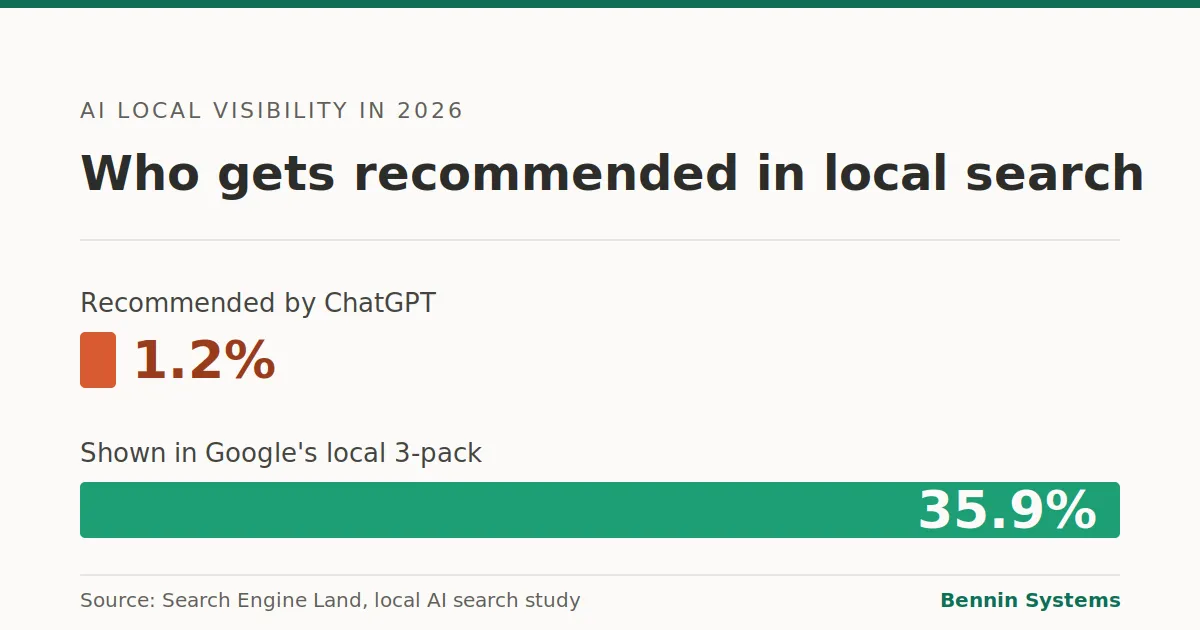
Here is why it compounds quietly. Research published by Search Engine Land found that AI local visibility is up to 30 times harder to achieve than traditional Google ranking. Only 1.2% of locations were recommended by ChatGPT in local searches, compared to 35.9% appearing in Google's local three-pack. The businesses getting recommended are the ones with structured, current, well-maintained digital presences. The businesses being skipped are the ones with a static website from 2019 and a Google Business Profile they update once a year.
Meanwhile, Ahrefs' December 2025 study found that when Google's AI Overviews appear on a search results page, the top-ranking organic result sees 58% fewer clicks. Google AI Mode launched to all U.S. users in May 2025 and is expanding globally. The search experience itself is changing underneath every business, whether that business is paying attention or not.
The erosion is not in your quality. It is in your findability.
What Does Jim Collins' Stockdale Paradox Have to Do With AI Adoption?
Jim Collins documented what he called the Stockdale Paradox in his research on companies that made the leap from good to great. Admiral James Stockdale survived over seven years as a prisoner of war in Vietnam. When Collins asked him who did not make it out, Stockdale said it was the optimists. The ones who said, "We'll be out by Christmas." Christmas came and went. Then Easter. Then the next Christmas. They died of broken hearts.
The paradox: you must never confuse faith that you will prevail in the end with the discipline to confront the most brutal facts of your current reality.
For small business owners, "I'll deal with AI later" is the optimist's Christmas. It feels like patience. It is actually a bet that the world will wait for you. The world is not waiting.
The faith side of the paradox matters just as much. An ordinary business owner can learn this. The tools are more accessible than they have ever been. The early movers are not geniuses or tech companies. They are solo operators and family businesses who decided to start.
What Ground Are Adapted Competitors Gaining Right Now?
The businesses that moved early on AI-ready operations are not running robots. They are doing three things differently.
First, they are publishing content consistently. Not because it is fun, but because consistent publishing is the primary signal both Google and AI answer engines use to determine whether a business is active, relevant, and worth recommending.
Second, they have structured their business information so machines can read it. Schema markup, clean metadata, updated Google Business Profiles, FAQ-formatted content. These are the labels that tell AI systems what a business does, where it operates, and who it serves.
Third, they have automated the follow-up. The SBA's Office of Advocacy noted that small businesses closing the AI adoption gap are primarily using it for customer communication, content creation, and operational efficiency. Not for replacing humans. For making sure no lead falls through the cracks while the owner is actually doing the work.
Every month that passes, businesses running these systems build compounding authority online. The gap widens. And the businesses that eventually do start will face a longer climb to catch up.
Is This the Same Thing That Happened When Tractors Replaced Horses?
The parallel is instructive. When mechanical tractors arrived in American agriculture in the 1920s and 1930s, adoption was not instant and refusal was not immediately fatal. The USDA's historical data on mechanization shows the adoption curve took decades.
But the farms that did not mechanize did not survive the century. Not because they were bad farmers. Many were excellent. They simply could not produce at the scale or efficiency that mechanized competitors achieved. The math eventually became impossible.
My hope for any business that chooses not to engage with AI is that they are so good at what they do it will not matter. That their reputation is strong enough, their relationships deep enough, their craft remarkable enough that customers will always find them regardless.
For some, that will be true. A beloved local business with three decades of relationships and more work than it can handle may never need to think about AI visibility. That business exists.
But for the majority, especially businesses that depend on new customers finding them, the math will look different in 2029 than it does today. Reality says the tractor is here. Being great at the old way is not enough when the field itself has changed.
What Does the Honest Timeline Look Like?
Here is what the next three years likely hold for a business that makes no changes to its digital presence or operational systems.
Year one (2026-2027): Minimal visible impact. You might notice fewer website inquiries but attribute it to market conditions or seasonality. Meanwhile, competitors with active content programs are building authority you cannot see.
Year two (2027-2028): The gap becomes measurable. AI answer engines are now the default search experience for a majority of queries. Businesses without structured, current content are systematically excluded from recommendations. You notice that newer competitors with smaller reputations seem to be getting more visibility.
Year three (2028-2029): The erosion becomes difficult to reverse quickly. The compounding advantage of early movers means their authority in AI systems is built on two to three years of consistent signals. Catching up requires not just matching their current output but overcoming the trust signals they have accumulated. The climb is steeper than it would have been in year one.
None of this is catastrophe. All of it is fixable, at any point, with effort and time. The honest truth is that the effort required grows with each year of waiting. That is the cost of delay, stated plainly.
What Does Starting Actually Look Like?
Starting does not mean becoming a technologist. It does not mean spending thousands of dollars on tools or hiring a consultant immediately. It means doing a few things that matter.
Update your Google Business Profile completely. Publish something to your website at least monthly. Make sure your business information is consistent everywhere it appears online. These are the baseline signals that keep you visible while you decide how far you want to go.
Beyond baseline, the businesses seeing real results are the ones with a content system (even a simple one), structured data on their website, and some form of automated follow-up for leads. Not because these are magic. Because they are the operational equivalent of having a tractor when everyone else still has a horse.
At Bennin Systems, the builds that make the most immediate difference for clients are exactly these: a content engine that keeps the business visible, a structured web presence that AI systems can read, and an automated follow-up system so no lead is lost to silence. We built these for Scotty's Oil, a family-owned petroleum company in Central Florida, where the chatbot Emma now captures and routes orders without anyone sitting at a desk. We built them for Nancy Clark's real estate practice in the Gallatin Valley, where the qualifier and pipeline system handles intake without dropping a single lead. The pattern is consistent because the problem is consistent.
What Is the Honest Tradeoff Here?
Every recommendation has a cost. The honest tradeoff of engaging with AI and automation is this: it requires time you do not have, learning you may not enjoy, and money (even if modest) that you would rather spend elsewhere. The payoff is not immediate, and there is no guaranteed timeline for results.
The tradeoff of waiting is this: the work you eventually have to do is the same work, but it takes longer and costs more because you are climbing from further behind. And the customers you lose in the interim are customers you will never know about, because they chose someone else before they ever found you.
Neither path is free. One costs time and money now. The other costs opportunity over time. That is the decision, stated honestly.
Frequently Asked Questions
Will my business fail if I do not use AI?
Probably not. Most businesses that ignore AI will not close because of it. What they will experience is a gradual decline in how often new customers find them through search, recommendations, and AI answers. The risk is not failure. It is invisibility to the people actively looking for what you offer.
How much does it cost to get started with AI for a small business?
The baseline costs nothing. Updating your Google Business Profile, publishing to your website, and formatting your content for machines are all free or nearly free. Beyond that, operational tools (CRM, automation, content systems) typically run $97 to $300 per month for a solo operator. Custom builds from a firm like Bennin Systems range from $1,500 to $10,000 depending on scope.
Is it too late to start in 2026?
No. The window is still open because the majority of small businesses have not built AI-ready operations yet. According to Federal Reserve monitoring data from April 2026, small business AI adoption is at 8.8%. You are still early. But earlier is better, because of how authority compounds in search systems.
Do I need to understand AI to benefit from it?
No. You need to understand what it does for your business at the level of outcomes, not at the level of how it works. You do not need to know how a tractor engine operates to plow a field. You need to know that plowing with a tractor covers ten times the ground in the same day.
What if my business runs on referrals, not search?
Referral businesses are increasingly being validated by AI before the referral converts. When someone recommends your business, the prospect often asks ChatGPT or Google about you before calling. If you have no digital presence to validate the referral, some percentage of those prospects will choose someone else.
What is the minimum I should do right now?
Three things: make sure your Google Business Profile is complete and current, publish at least one piece of helpful content per month on your website, and ensure your contact information is consistent across every platform where your business appears. This baseline keeps you in the game while you decide how much further to go.
Can I do this myself or do I need to hire someone?
The baseline you can do yourself. Beyond that, the question is whether your time is better spent learning systems architecture or running your business. For most owners, the answer is to hire someone for the initial build and learn to maintain what they built. That is the approach that respects both your time and your budget.
What is the difference between AI hype and what actually matters for my business?
The hype is about replacement, disruption, and revolution. What actually matters is simpler: can new customers find you when they search, does your business information make sense to machines, and are you losing leads to slow follow-up. If those three things are handled, you are ahead of most competitors regardless of what anyone says about AI on LinkedIn.
Bennin Systems, Paradise Valley, Montana. (406) 224-3267. benninsystems.com
Stacy Bennin is the founder of Bennin Systems, an operational systems and AI automation consultancy based in Paradise Valley, Montana. She builds custom websites, automated client acquisition systems, brand identity, and operations workflows for small businesses, real estate professionals, and family operations. She is also a licensed Montana real estate broker affiliated with Legacy Lands Real Estate. Reach her at benninsystems.com.
